Problems on Techniques of Integration

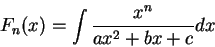
The answer is given in any Table of integrals. Here we try to give the details for getting the answer. Since the degree of the numerator is bigger than the degree of the denominator, we will perform the long division to get


\begin{displaymath}\frac{x^n}{ax^2 + b x + c}= \frac{1}{a} x^{n-2} - \frac{1}{a}\;\;\frac{bx^{n-1} + cx^{n-2}}{ax^2 + b x + c}\end{displaymath}

So

\begin{displaymath}\int \frac{x^n}{ax^2 + b x + c}dx = \frac{1}{a(n-1)}x^{n-1} - \frac{1}{a}\; \int \frac{bx^{n-1} + cx^{n-2}}{ax^2 + b x + c}dx\end{displaymath}

or

\begin{displaymath}\int \frac{x^n}{ax^2 + b x + c}dx = \frac{1}{a(n-1)}x^{n-1} -...
...b x + c}dx - \frac{c}{a}\;\int \frac{x^{n-2}}{ax^2 + b x + c}dx\end{displaymath}

In other words, we will obtain the given integral by the above recurrent formula. Indeed, set

\begin{displaymath}F_n(x) = \int \frac{x^n}{ax^2 + b x + c}dx\end{displaymath}

then we have

\begin{displaymath}F_n(x) = \frac{1}{a(n-1)}x^{n-1} - \frac{b}{a} F_{n-1}(x) - \frac{c}{a} F_{n-2}(x)\cdot\end{displaymath}

It is then enough to know $F_0(x)$ and $F_1(x)$ to generate all of the functions $F_n(x)$.


If you prefer to jump to the next problem, click on Next Problem below.

[Next Problem] [Matrix Algebra]
[Trigonometry] [Calculus]
[Geometry] [Algebra]
[Differential Equations] [Complex Variables]

S.O.S MATHematics home page

Copyright © 1999-2004 MathMedics, LLC. All rights reserved.
Math Medics, LLC. - P.O. Box 12395 - El Paso TX 79913 - USA